
On a home-services marketplace, the star rating is the product. A customer with a leaking pipe doesn't read profiles for long. They scan a list of plumbers, look at the stars and the last few comments, and tap the one that looks safest. The provider with 4.9 gets the job. The one with 4.2 waits.
That makes the review system one of the most valuable parts of the platform. On many small and mid-size marketplaces it is also one of the least controlled. Anyone with an account can leave a rating. Support staff delete reviews that look unfair, and nobody records why. Providers ask friends for five stars. And when a provider asks why their average dropped, nobody can explain how it was calculated.
Regulators have stopped treating this as a nuisance
Fake reviews used to be seen as a reputation problem. They are now a legal one.
In the UK, the Digital Markets, Competition and Consumers Act made fake reviews, hidden incentives for reviews and misleading presentation of reviews banned practices from April 2025. The Competition and Markets Authority's guidance says businesses that publish reviews must take steps to prevent and remove them. In March 2026 the CMA opened five more investigations into fake and misleading reviews. According to the CMA, the cases cover concerns such as unpublished one-star reviews, reviews written by staff, possibly inflated star ratings and discounts offered for five-star reviews. Under its new powers the CMA can fine up to 10% of global turnover.
In the US, the Federal Trade Commission's rule on consumer reviews and testimonials took effect on 21 October 2024, two years ago today. In May 2026 the US Department of Justice, acting for the FTC, and the State of Illinois sued a home-repair lead business. They allege it created thousands of fake business listings and posted fabricated five-star reviews to bury real one-star ones.
The CMA also warns consumers that AI-written reviews now read fluently and convincingly. A human moderator can no longer catch a fake review just by how it reads.
You don't need to operate in the UK or US for this to matter. These cases show what a well-run review system is now expected to do, and customers everywhere are learning not to trust stars that can't be explained.
Where review systems usually break
When we look at marketplace admins, the same gaps come up:
- Reviews aren't tied to a job. A rating can exist without a completed, paid booking behind it, so there's no way to prove the reviewer ever used the service.
- Moderation leaves no trace. A review is hidden or deleted with one click. Later, nobody can say who removed it, when or why. That is exactly the kind of quiet suppression regulators now ask about.
- Incentives are invisible. If a provider offered a discount for a good review, the platform has no way to label it.
- The average is a black box. The star score is whatever the code computes. There is no written rule for which reviews count or how flagged ones are treated.
- Signals live in different places. Reviews, complaints, job history and on-site presence sit in separate screens, so patterns go unseen. Examples are the same client rating the same provider again and again, or a burst of five-star reviews on brand-new accounts.
Treat reviews as operations, not decoration
The fix is not a smarter star widget. It is a small set of rules and screens in the admin:
- One review per completed job. Only the client of a finished job can review it, and the job ID is stored on the review. Where the platform already tracks providers on site, the review can be checked against that visit.
- A flag queue with reasons. Customers, providers and staff can flag a review. Each flag carries a reason and lands in a queue with a clear owner and status: pending, approved or flagged.
- A log for every decision. Hiding, restoring or editing a review records who did it, when and why. You keep the review and the record, not just the outcome.
- Labels for incentives. If a review came with a discount or reward, it says so on the profile.
- A published averaging rule. Write down which reviews count toward the star score and how flagged or hidden ones are handled. Then make the code follow that rule.
- Pattern alerts. Watch for bursts of reviews, repeat client-provider pairs, new accounts that only leave five stars, and reviews on jobs that never reached the site.
- A right of reply. Providers can answer a review publicly, which is often fairer than deleting it.
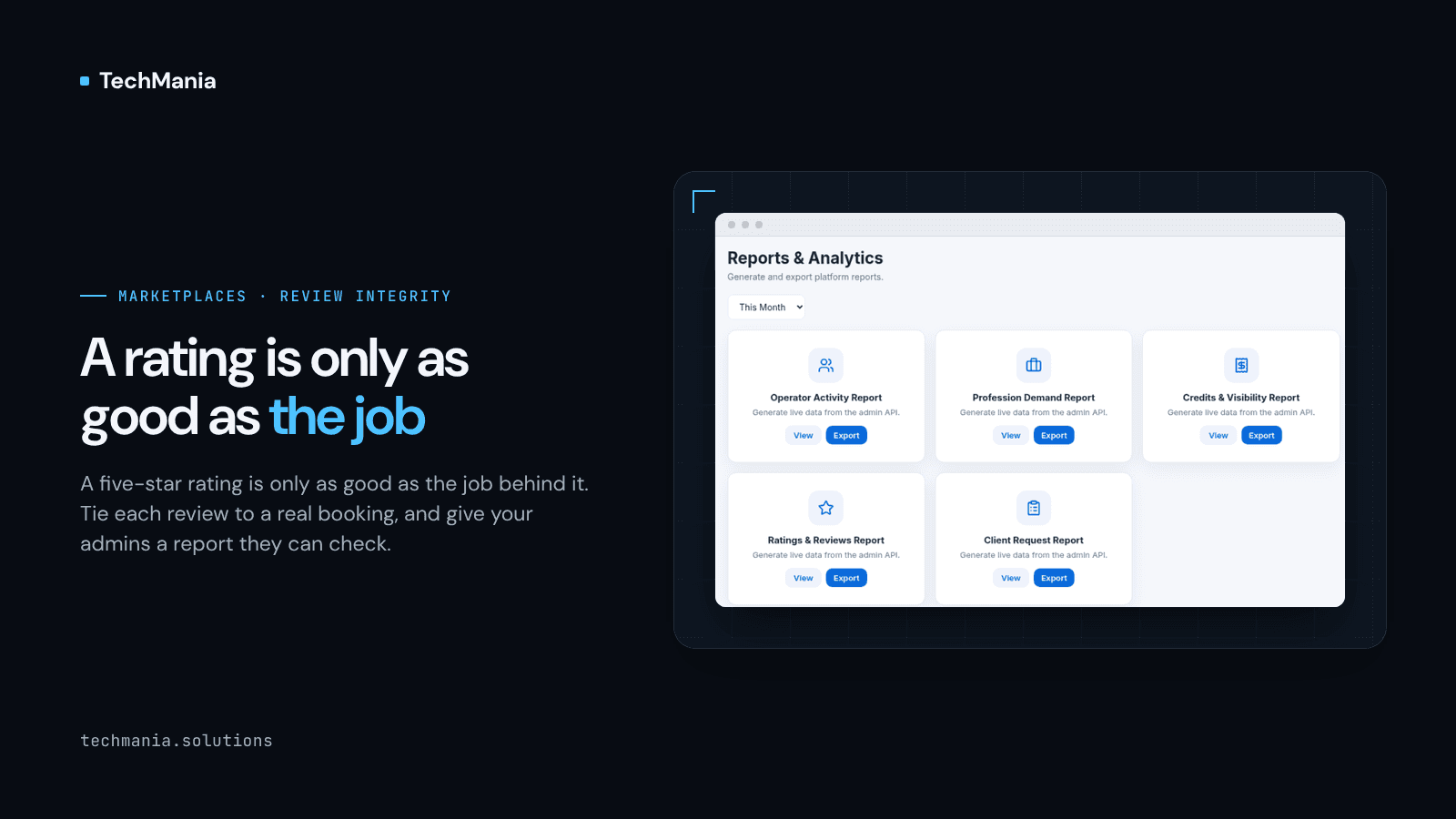
- One report. A ratings and reviews report that sits next to complaints and job outcomes, so the team can see where a provider's stars and actual service quality disagree.
None of this needs a large trust-and-safety team. It needs reviews to be first-class records in the admin, with the same care as payments or verifications.
What we bring to it
We built JobBox, a home-services marketplace with a Laravel admin and Flutter apps for customers and service pros. Its admin already treats reviews as their own module. There is a Reviews list with a Credibility Management tab and Flag actions. Each review row carries the rating, the comment, both parties and the job ID, with a pending, approved or flagged status. There is also a Ratings & Reviews report beside operator activity and client request reports, plus activity logs, a complaints module and geofence events that show when a pro arrived on site or left it.
These are the building blocks the steps above rely on. Job-locked reviews, logged moderation decisions, incentive labels and pattern alerts are what we would scope on top of a setup like this for a marketplace that wants its ratings to hold up.
Questions to ask about your own platform
- Can a customer review a provider they never booked?
- If a review was hidden last month, can you say who hid it and why?
- Could you explain, in writing, how a provider's star average is calculated?
- Do your reviews and complaints ever appear on the same screen?
If most answers are "no", your ratings are carrying more weight than your system can support.
This article describes a common operating pattern and is not legal advice. Check the rules that apply in the markets you serve.
Running a service marketplace and want ratings you can stand behind? Talk to us at https://techmania.solutions