
Most fleets already have a speeding badge.
Somewhere in a device portal there is a harsh-braking tile, an overspeed counter, or a colour chip that turns red when a vehicle breaks a limit. That badge is useful. It is also table stakes. It is not a Risk & Safety product, and it is not a control tower.
The gap shows up on Monday morning. Safety wants a score they can explain. Ops wants the live map, geofences and unread alerts in the same place. Billing or compliance wants a mileage export. Each of those asks is answered in a different tool — or not answered at all — while the "risk" widget sits alone on a dashboard nobody coaches from.
What stock badges usually are
Device portals and stock tracking UIs are good at events: overspeed, harsh acceleration, idle, ignition. They list them, sometimes colour them, sometimes email them. What they rarely do is turn that stream into an explainable score stack with categories, trends and export, sitting beside the same map and the same exception list the dispatcher already uses.
Harsh-driving scores are easy to ship as a widget. Analytics-as-product is a different job: category scores (acceleration, braking, speed, fatigue and related), a trend the team can read, an export for the conversation that needs a file, and the weekday surfaces — live map, geofences, alerts — in one workspace.
Why the control tower is a different product
A control tower, in this sense, is not a new map. It is one product surface where:
- Risk & Safety is a first-class module — global and category scores, filters by period and vehicle, trend and export — not a badge bolted onto a device card.
- Mileage and trip reports export from the same product the map lives in, so ops does not reconcile a CSV from one vendor with a live view from another.
- Geofences and alerts share thresholds, filters and a mark-read cadence with the same fleet the scores describe.
- Live map and device inventory stay one click away from the score and the alert, so coaching and response do not start with a tool hop.
Without that, insurance and broker conversations still ask for evidence the portal cannot assemble, and ops still hops between map, inbox and spreadsheet.
How buyers mis-frame the RFP
Fleet and telematics buyers often mix four different buy paths: end-fleet SaaS suites, white-label TSP platforms, open-source tracking kernels, and protocol hubs. Mis-framing the RFP is how a team ends up with stock harsh-driving scores that never touch mileage export or the weekday exception list.
Enterprise suites ship map plus harsh scores. That can be the right buy for some fleets. It is still a different decision from owning a Risk & Safety and mileage analytics surface shaped around your ops — scores, reports, geofences and alerts as one product, not a badge on someone else's seat license.
Where the scoring work actually sits
On GeoLox, the work sits in two layers.
The customer portal — Risk & Safety screens, live map, alerts, geofences, reports — was built and customized for a client. Those are the surfaces a fleet or safety manager opens.
The GeoLox Admin scoring engine behind those portal scores is something we built end to end. The Admin also holds the operator pieces that keep scores and devices honest: scoring policies, Traccar sync, per-device subscriptions and related risk modules.
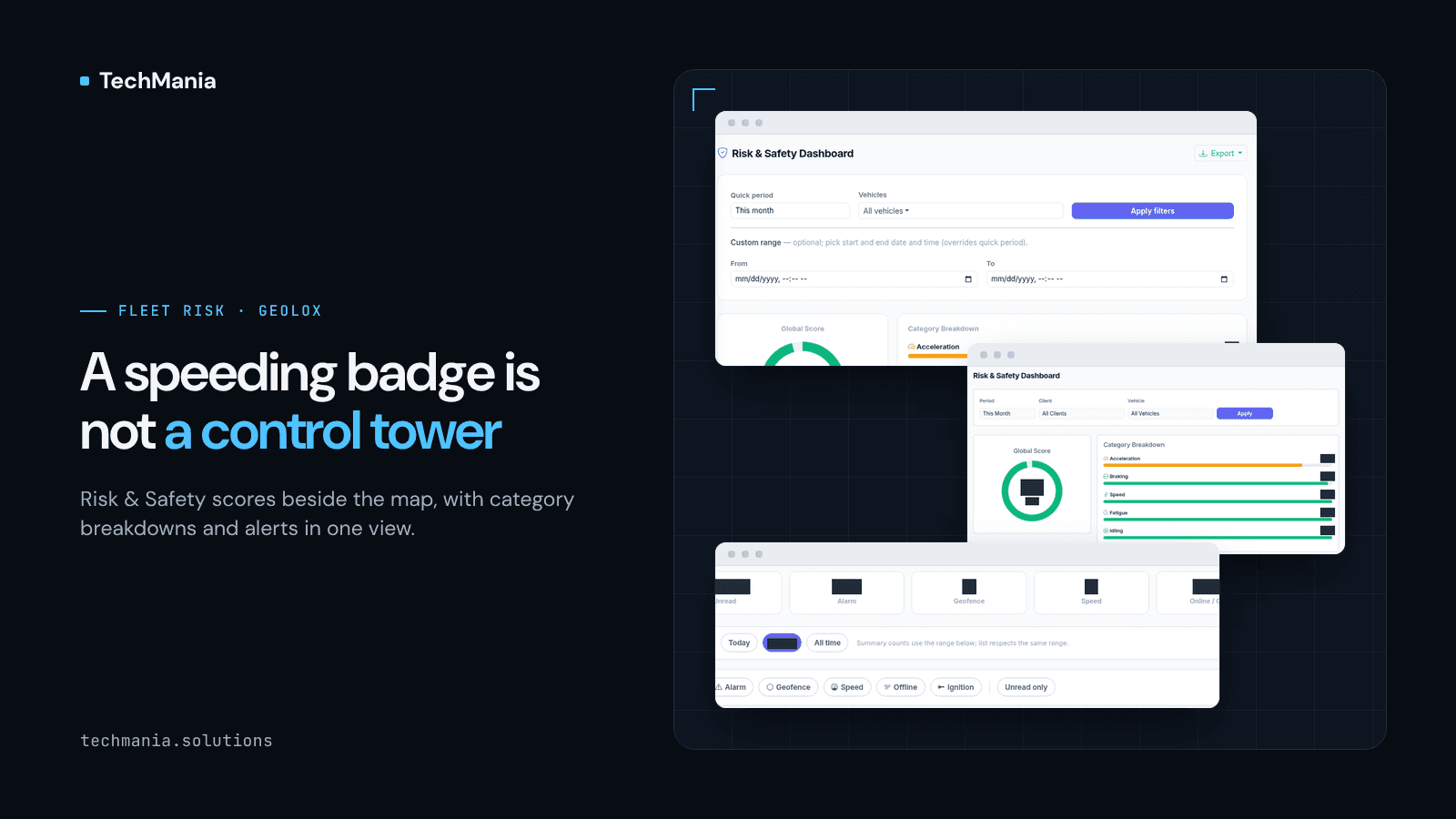
On the Admin side, that means a Risk & Safety dashboard with a global score and category breakdown (acceleration, braking, speed, fatigue, idling), plus fleet score trends. On the portal side, Risk & Safety sits beside alerts and reports — the control-tower shape, not a lone speeding badge.
A short checklist for telematics product owners
- Is Risk & Safety a module with categories and export, or only a harsh-event badge?
- Do mileage and trip reports live in the same product as the live map?
- Can a supervisor filter alerts and geofence events without leaving the score context?
- If an insurer or broker asks for evidence, can ops pull score trend and mileage from one place?
- Are you buying (or building) a seat in a suite, a white-label skin, a tracking kernel, or an owned analytics surface — and did the RFP say which?
If the honest answers point at a badge and three other logins, the gap is product shape, not another sensor.
Talk to us
We build Laravel admin panels and fleet portals — including risk-scoring engines and the ops surfaces around them — for GPS and telematics teams. If you want Risk & Safety, mileage reports and weekday exceptions on one control tower instead of a speeding badge alone, talk to us at https://techmania.solutions