
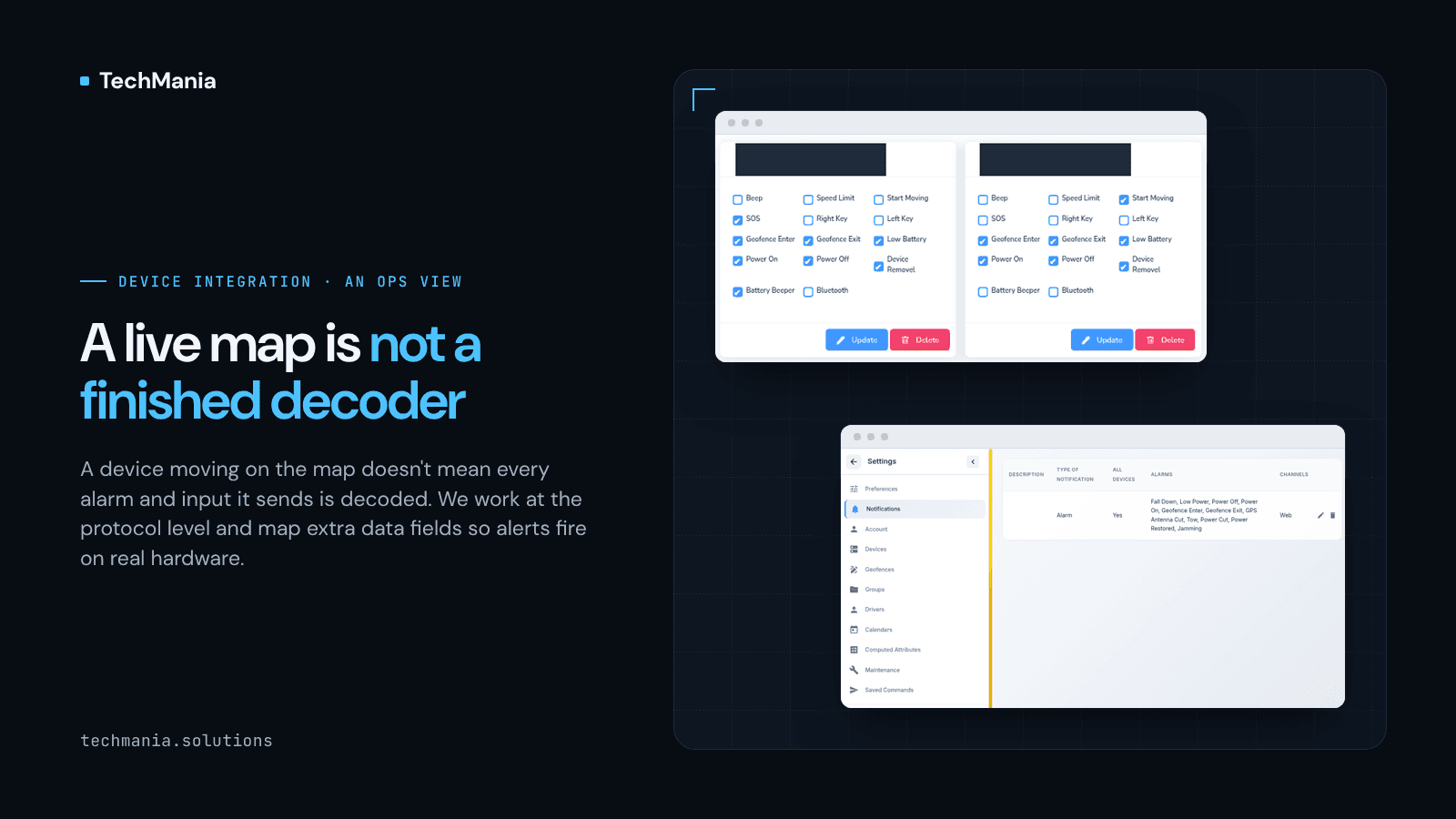
Most GPS platforms built on Traccar reach a point that looks like launch day. Devices are online. Positions arrive. Pins move on the map, trips appear, and the first customer logs in without complaint.
Then the support tickets start to sound alike. "The tracker sends a low-battery warning, but nothing shows in the portal." "We installed the new model and tow alerts never fire." "The spec sheet lists that input, so why is the field empty?"
None of those are map problems. The map is fine. What is unfinished is the layer underneath it: how the server decodes what each device actually sends, and whether those signals become fields, alarms and events your product can use.
Position is the easy part
Traccar supports a very wide range of tracker protocols, and Teltonika devices are among the best covered. For latitude, longitude, speed and ignition, stock support usually just works. That is a big reason so many operators start with it.
The trouble is that a modern tracker sends much more than position. Teltonika devices report a long list of I/O elements: battery and power state, inputs and outputs, tamper and crash events, CAN or OBD values, and parameters that differ from one model family to the next. Those values travel inside the Codec 8 or Codec 8E data the device sends, and the server has to know what each ID means for that specific hardware before it can do anything useful with it.
This is where "Teltonika works with Traccar" quietly becomes "our model's parameters mostly work." Teltonika documents differences in AVL IDs between device platforms, so the same number does not always mean the same thing across families. The public Traccar project also shows ongoing work to add device models and parameter mappings to its Teltonika decoder. That is healthy open-source progress. It also means stock decoding is still unfinished for many real-world models, and your hardware mix may sit right in that gap.
What the gap looks like from the business side
Operators rarely describe this as a decoder problem. They describe symptoms:
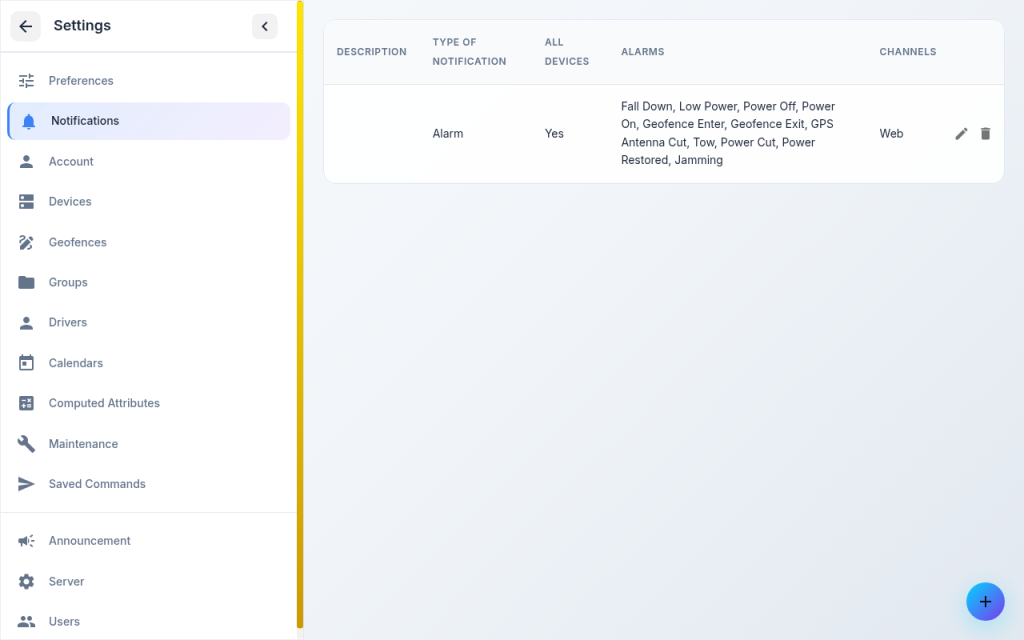
- Alerts that never fire. Power cut, tow, jamming or low battery are configured in the notification rules, but the device's version of that event is not mapped to the alarm the rule is waiting for.
- Empty or wrong fields. A value the hardware definitely sends shows up as a raw attribute with a number for a name, or does not appear at all.
- Reports nobody trusts. If an input is decoded inconsistently across models, any report built on it is only right for part of the fleet.
- Launches that stall mid-project. A new customer brings a model the platform has not handled before, and the commercial timeline now depends on protocol work nobody scoped.
- "Device sends X, portal shows nothing." The most expensive support ticket, because it takes someone who can read the raw data to answer it.
Why a better UI does not fix it
In an earlier post we argued that many Traccar operators do not need server changes at all: their data arrives correctly, and what they are missing is a branded web and mobile product on the standard APIs. That is still true for plenty of businesses.
This is the opposite case. If the signal is never decoded, no amount of front-end work can show it. A new dashboard will display an empty field more beautifully. Computed attributes can rename or combine values that did arrive, which helps with small gaps. They cannot fix data the decoder dropped, misread or interpreted differently across models.
That is why it helps to diagnose before you rebuild. Ask a simple question: is the data in the raw positions coming from the server, correctly labelled, for every model you sell? If yes, your gap is the product layer. If no, it is a protocol job, and it should be scoped as one.
What protocol productization actually involves
Fixing this properly is less about one clever patch and more about treating decoding as part of the product:
- Know your hardware mix. List every model and firmware family you deploy, not just "Teltonika."
- Map what each model actually sends. Compare the device documentation with what arrives in raw data, and note which I/O elements matter commercially.
- Change the protocol handling where needed. Adjust how Codec 8 / 8E data is decoded for those models so the right IDs become the right attributes and alarms.
- Expose the fields through the API data your product uses, so web and mobile apps receive real, named values instead of raw numbers.
- Only then build alerts, reports and admin tools on top. Alarm rules and per-model alert settings are only as reliable as the decoding behind them.
What we have done in this space
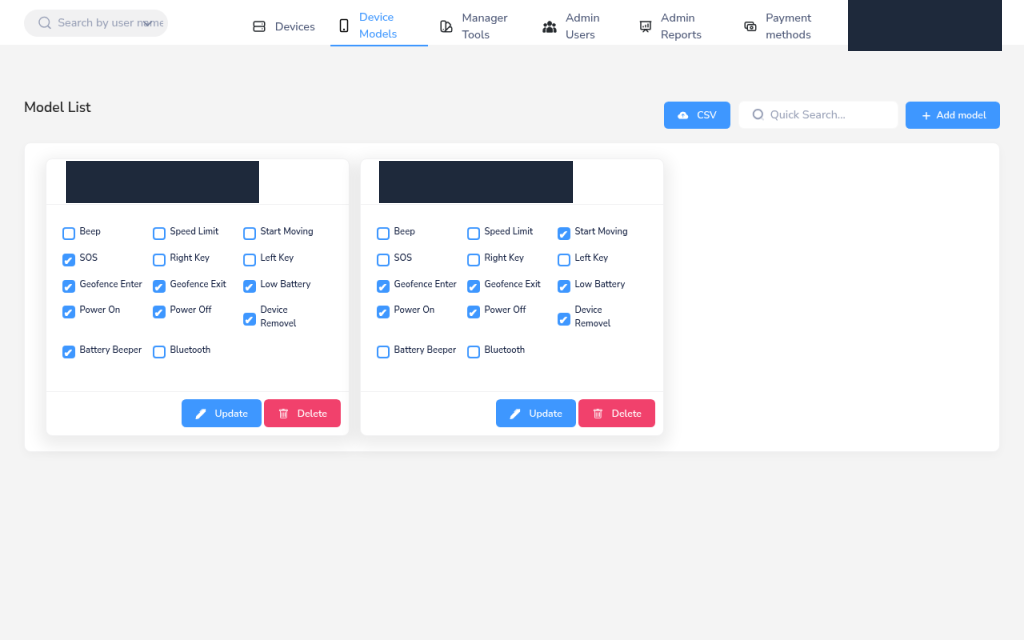
When we built UTrack end to end for Utrack Inc, a US tracking service, the work went beyond the Laravel web admin and the Flutter iOS and Android apps. We set up and customized the Traccar backend, including changes at the protocol level. On the admin side, alert capabilities are managed per device model, because what a product can promise
For the GBL Tracking System, built for GBL Rental Express in Brisbane, we customized Traccar's frontend and backend. On the backend that included device protocols, API data and additional data fields, alongside the rental features that portal is known for.
More broadly, our team works with Teltonika devices and Codec 8 / Codec 8E data inside Traccar-based platforms, and we treat decoder work and product work as two parts of one build, scoped separately so neither hides inside the other.
A short checklist before your next release
- Pick your three most-deployed models and check one important I/O value on each in raw data.
- Trigger a test alarm you care about (power cut, tow or low battery) and confirm it reaches the portal as the right event.
- Look for attributes that arrive as bare numbers. Each one is a parameter nobody has mapped yet.
- Ask whether your next new hardware model has a decoding plan, or just a sales date.
- Decide whether your next sprint is a UI job, a protocol job or both, and scope them separately.
A live map proves your server can see your devices. It does not prove your product understands them. If your trackers are saying more than your portal shows, talk to us at https://techmania.solutions.