
Ask a fleet owner in Pakistan what has changed this year, and fuel comes up before anything else.
Since July 2026, petrol and diesel prices have been notified every working day instead of on a weekly or fortnightly cycle. High-speed diesel climbed past Rs520 a litre in early April before easing to around Rs398 in October, as reported by Dawn. Goods transporters raised freight charges twice in September. And from 17 September, the federal government cut the fuel allocation for official vehicles by half for three months.
For anyone running vehicles, that turns fuel from a monthly line item into a daily decision. And it changes the question people ask their tracking company. It used to be "where is my vehicle?" Now it is "where did my fuel go?"
Most tracker apps are built to answer the first question very well. Very few answer the second.
What a location-only tracker leaves out
A typical tracker app shows a live map, a trip history and a handful of alerts. That is useful, but look at what a fleet owner actually needs when the fuel bill lands:
- Fuel per vehicle and per trip. Not a monthly total from the pump, but how much each vehicle used on each run, next to the distance it covered.
- Idle time with the ignition on. A vehicle waiting at a depot with the engine and AC running burns fuel without moving a metre. On a map it looks parked. In the fuel bill it does not.
- Engine hours. For vans and trucks that spend long periods running at low speed, engine hours tell a truer story than kilometres.
- Spend in rupees. Finance staff do not read GPS logs. They need a figure per vehicle and period they can put next to the pump slips.
When that information is missing from the app, it gets rebuilt by hand. Pump slips are collected, drivers' claims are taken on trust, meter photos arrive on WhatsApp, and someone reconciles it all in a spreadsheet weeks later. By the time a problem shows up, the fuel is long gone. And the tracker company's control room takes the "why is my bill so high?" call without anything useful in front of the customer.
Fuel belongs beside tracking, not in a separate portal
Some tracker companies sell fuel monitoring as its own product, with its own dashboard. That can work, but it splits the evidence. The fuel data sits in one place, while the trips, alerts and playback that explain it sit in another.
The useful version puts them together in the app the customer already opens every day:
- Trips that show fuel alongside distance and average speed, so an unusual run stands out.
- Idle and ignition alerts in the same alerts list as geofence and overspeed, so wasted running time is flagged the same day.
- Reports for speed, engine hours, fuel and spend per vehicle, for this week or this month.
- A fuel usage chart that shows the trend, not just the latest number.
- Route playback, so a high-fuel day can be checked against where the vehicle actually went.
None of this needs a new tracking platform. If the tracking server already records positions, ignition and trips, the work is in the product layer: the reports, alerts and screens that turn that data into answers.
Be honest about where the fuel number comes from
There is one decision to make early, and it matters more than the screen design: where the fuel figure comes from.
- A tank sensor or the vehicle's CAN bus data measures fuel directly, but only on vehicles that have it.
- An estimate from distance, engine hours and a set consumption rate works on any tracked vehicle, but it is an estimate, and the app should say so.
Spend has its own catch. If spend is calculated from a price per litre, that price has to follow what the fleet actually pays. With prices now changing every working day, a rate typed in once will drift away from the real bill within days.
Whichever approach a fleet uses, the report should be clear about it. A fleet owner can work with an estimate. What erodes trust is an estimate that looks like a measurement.
Who this matters to
- Tracker companies whose customers now judge the app on fuel answers, not just the live map.
- Transport and distribution fleets where fuel is the cost that moves the most.
- Corporate and institutional fleets working within a reduced fuel budget, who need per-vehicle evidence of what was used and where.
How we approach it
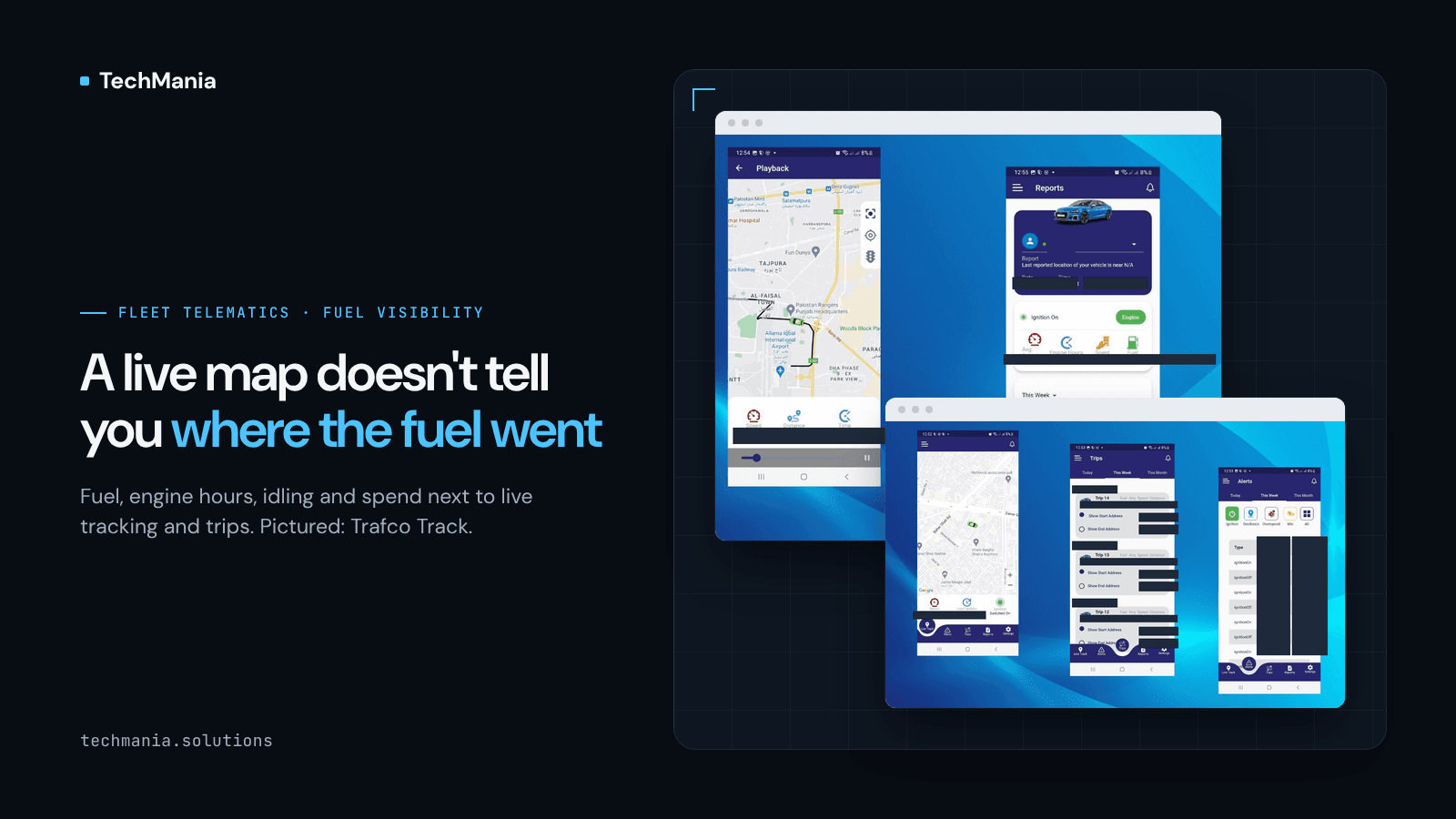
We built Trafco Track end to end for TRAFCO TRACKING (PRIVATE) LIMITED: a Flutter app for Android and iOS, with Laravel and Traccar behind it. Alongside live tracking by registration number, route playback and trips, the app has alerts for ignition, geofence, overspeed and idle, reports for speed, engine hours, fuel and spend in rupees, and a fuel usage chart, all in the same app the customer uses to find the vehicle. You can see the full build in our Trafco Track case study.
We have built the same report pattern for other markets too. ProGPS, which we built for a client in Romania on Traccar's standard APIs, includes summary reports with fuel and engine hours that export to PDF and Excel.
For a tracker company, this can be an add-on to an existing Traccar-based platform (fuel, idle and spend reports and alerts in the current app) or part of a branded Flutter and Laravel product built from the ground up. We build the software. We do not supply sensors or install devices, and we do not promise a fuel saving. What we can give your customers is a clear, per-vehicle view of where the fuel went.
Next step
If your customers are asking where their fuel went and your app can only show them where the vehicle is, talk to us at https://techmania.solutions