
For years a motorway toll was the renter's problem. They drove up to a barrier, paid, and drove on. The rental agency never saw it.
Free-flow tolling changes that. On barrier-free sections of French motorways there is no booth and no barrier. Cameras on gantries read the plate as the car passes, and the driver is expected to pay afterwards, online or at a partner point, within 72 hours. Free flow already runs on the A79 in the Allier, on the A13 and A14 between Paris and Normandy, and at the Boulay junction on the A4. The A69 between Toulouse and Castres has been announced as the next one, and the State says future motorway projects will use free flow too.
Most drivers who own their car get used to it. Renters are a different story. Many don't know the section was free flow, some assume the rental company pays, and plenty simply forget. When the 72 hours pass, the motorway operator sends a payment notice to the registration holder. For a rental car, that is the rental company.
A second fines stream, on a different clock
Rental agencies in France already know this pattern from ANTAI: a speed camera or parking notice arrives, someone finds the driver for that date and designates them. Free-flow toll notices look similar, but they are a separate stream with their own portal, their own deadlines and their own file format.
According to Service Public, an unpaid passage costs the toll plus a €10 surcharge if it is settled within 15 days of the notice, €90 after that, and €375 after two months. Sanef, which runs the A13/A14 free flow, publishes a dedicated procedure for rental companies: designate the renter notice by notice on its website, or send a designation file in Excel through the company's customer account. A refused designation has to be redone, and if the operator asks for the rental contract and doesn't get it, the notice comes back to the agency.
After the Paris–Normandy free flow opened, French press reported rental agencies on that corridor talking about an "avalanche" of unpaid-toll notices and about adding admin fees for renters. We don't have numbers for any single agency, and we won't invent any. The process alone explains why it hurts.
What the work looks like today
In many agencies, toll notices are still handled the slow way:
- Someone opens the letter, reads the plate, date and time, and searches the rental history for the contract that covered that moment.
- They copy the renter's identity into the operator's website, or into the operator's Excel template, by hand.
- They track which notices were accepted, refused or re-issued in a spreadsheet, if at all.
- Finance learns about the toll after the renter's deposit has already gone back, so the amount and any admin fee are written off or chased.
The rental software often handles ANTAI fines well and has no idea toll notices exist. So tolls end up in a side spreadsheet, outside the contract, outside the renter's balance and outside any deadline reminder.
Treat a toll notice as one more fine type
The fix isn't a new system. It is the same discipline a good fines workflow already applies, extended to one more notice type.
1. Capture the notice once. Upload the letter, or read it with OCR, into the same queue as other fines, with its own type: free-flow toll. Store the scan with the record.
2. Match it to the contract automatically. Plate plus passage date and time should point to exactly one rental contract. If contract start and end times are recorded properly, this is a lookup, not a search. If no contract matches, the car was in the agency's hands and the notice goes to the agency's own payment queue instead.
3. Generate the designation file in bulk. Instead of typing each renter into a website, the admin builds the operator's Excel designation file from the matched contracts, ready to upload. Notices that need the contract as proof get the contract PDF attached from the rental record.
4. Track status and deadlines per notice. Each toll notice carries a status (new, designated, accepted, refused, re-issued, paid by the agency) and the date by which it must be handled. Refusals come back into the queue with the reason instead of disappearing.
5. Put the cost on the renter's balance before the deposit goes back. The toll, and any admin fee the rental terms allow, should land on the renter's balance or weekly invoice as a charge, so it is settled at the end of the contract rather than discovered a month later.
6. Prevent the next one at the counter. A short departure checklist item, "this car may use free-flow motorways, here is how to pay within 72 hours", costs nothing and cuts the volume at the source. Operators also let a renter register the plate for the rental period so only their trips show.
Where this fits in a rental admin we built
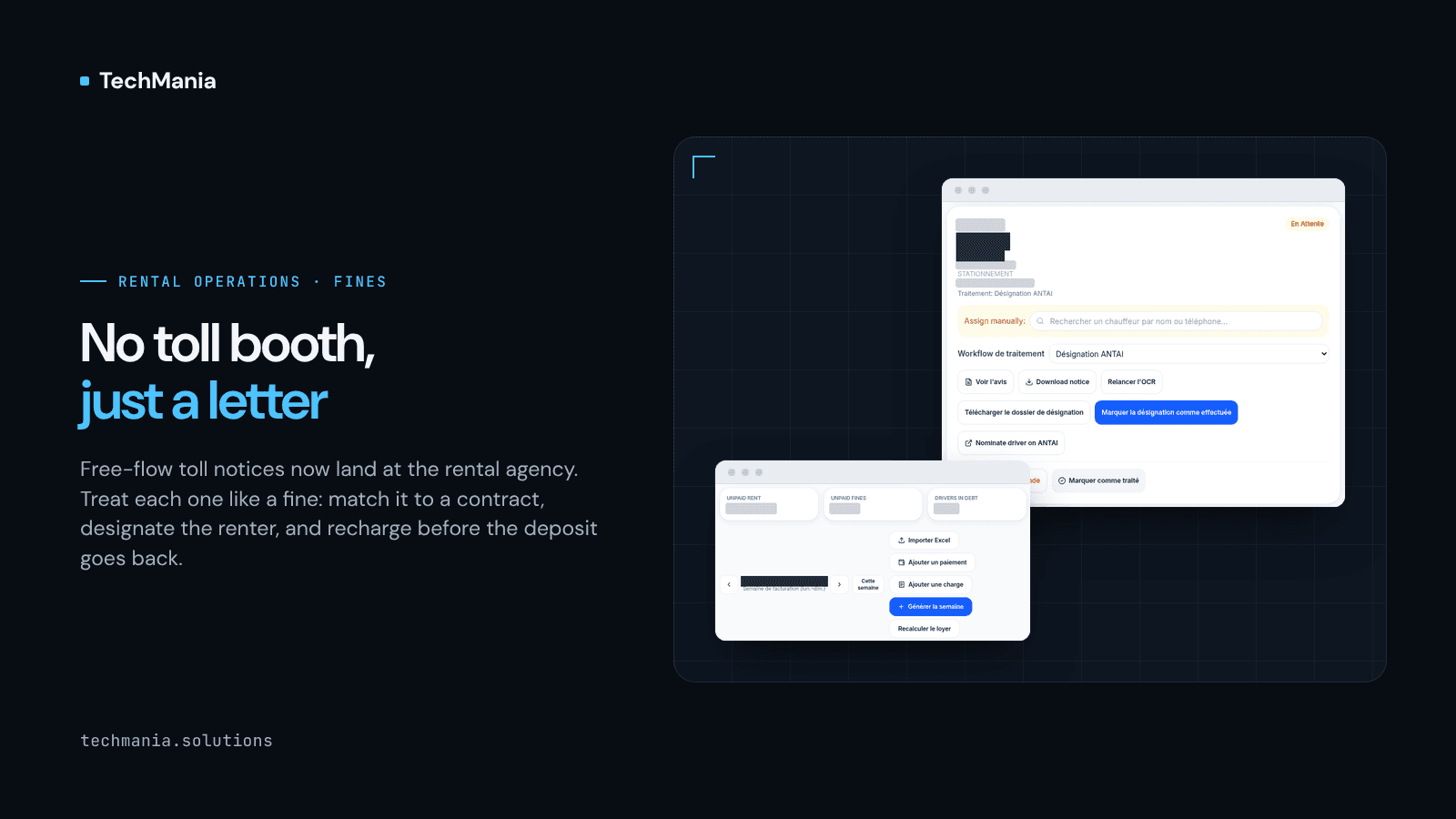
We built FleetFlow end to end: a French-language operations admin for vehicle rental fleets. Its fines workbench already covers the ANTAI side of this loop. Each fine has a processing workflow such as ANTAI designation, staff can view or download the notice, retry OCR, download the designation file, nominate the driver on ANTAI and mark the designation as done, and the queue supports ANTAI CSV export and bulk import. Processed fines move to their own archive. Next to it, weekly invoicing lets staff add charges and payments to a driver's week and shows unpaid rent, unpaid fines and drivers in debt.
FleetFlow does not handle free-flow toll notices today, and we are not claiming it does. But the building blocks above (a typed fines queue, OCR, designation files, a processed archive and charges on the renter's weekly balance) are exactly what a toll-notice type needs. For an agency that already has a rental admin, the same pattern can be added as a module: one more notice type, a contract-matching rule, an export in the operator's format, and a link to billing.
Questions to ask your own back office
- How many toll notices arrived last month, and how many were designated before the €10 window closed?
- Can you find the contract for a plate and a timestamp in under a minute?
- Do tolls and admin fees reach the renter's balance before the deposit is released?
- Do renters hear about free flow at the counter?
If the answer to most of these is "not really", toll notices are already a fines queue in your agency. It just isn't in your software yet.
This article describes a common operating pattern and is not legal advice. Check the current rules and the operator's procedure for your own fleet.
Running rental operations in France and want toll notices to work like the rest of your fines? Talk to us at https://techmania.solutions