
If you run a GPS tracking platform, the 2G switch-off is already happening around you. In France, Orange is shutting 2G down in steps: Nice on 22 September 2026, 44 departments on 6 October and the remaining mainland departments on 20 October, with regulated white zones following in December. Orange itself lists vehicle geolocation solutions among the equipment affected. SFR and Bouygues Telecom follow in November and December, according to Arcep. In the US, T-Mobile retired its 2G GSM network on 3 August 2026.
Most of the advice out there is about hardware: which LTE-M or 4G trackers to buy, and which SIMs to move to. That matters. But for a tracking operator, the harder question comes first, and it's an operations question: which of our units are at risk, who do they belong to, and what happens to their data and their subscription when we swap them?
The date that matters is the SIM's network, not the country
Inside one country, carriers switch off on different dates. A tracker on an Orange SIM in one department may go dark weeks before an identical unit on a Bouygues SIM. A 2G-only module needs replacing; a dual-mode module may only need a SIM or profile change.
So a useful risk list can't stop at "France". You need each unit's model, its module type, the carrier behind its SIM, and the customer and plan it belongs to. Without that, the first warning you get is a support ticket saying "my vehicle stopped reporting".
Why the stock device list isn't enough
Most tracking servers store a device's name and unique ID, and not much more. The SIM vendor's portal knows the ICCIDs but not the customer or the vehicle. Stripe or your billing tool knows who pays, but not which tracker replaced which. So the swap campaign ends up in a spreadsheet that matches three exports by hand, and it's out of date the day after it's built.
Then the swap itself creates new problems:
- Continuity breaks. A new tracker means a new IMEI. If it's added as a fresh device, trip history, geofences, alert rules and driver links don't follow it.
- Billing drifts. The old unit keeps a live subscription, or the new one isn't linked to the customer's existing plan and renewal date.
- Protocols change. Replacement hardware often speaks a different protocol or codec, which the server has to decode correctly before any of the above matters.
- Customers go quiet. For rental, insurance-telematics or risk-scoring customers, a gap in data hits contract checks and scores, not just the live map.
What a swap-ready operator back office looks like
You don't need a new platform for this. You need a few things in the operator Admin you already run:
- One device inventory. IMEI, ICCID, model, owner, plan and expiry in one table, with filters and CSV export, so ops can see the fleet the way the business sees it.
- Per-model attributes. Store module technology and network on the device model, so you can filter "2G-only units on carrier X" instead of guessing from install dates.
- A risk report by sunset date. Group at-risk units by carrier switch-off date and by customer, so customer success knows who to contact first.
- Bulk subscription tools. Change expiration dates, pause or cancel subscriptions, and move units to a new renewal group in bulk while hardware is being swapped, instead of editing records one by one.
- A replace-device flow. Move the customer, plan, geofences and alert rules from the old IMEI to the new one, so history stays continuous.
- Decoder support for the new hardware. Make sure the server reads the replacement trackers' protocol correctly before the first unit is installed.
- Customer notices through channels you already have. Use your existing in-app, SMS or email alerts to tell customers what's changing and when.
What we've built that applies
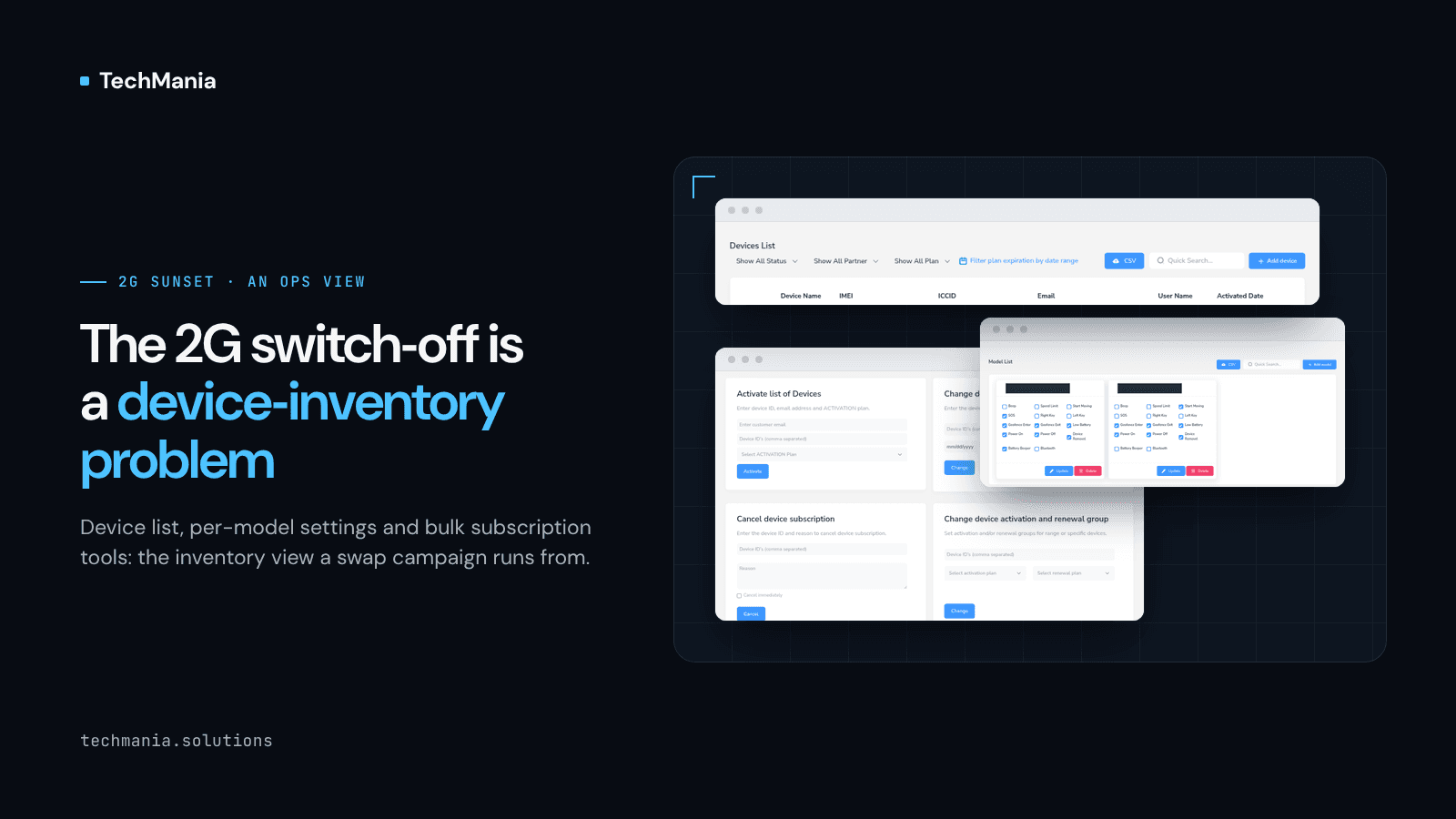
We built the UTrack operator admin end to end: a device table with IMEI and ICCID, owner and activation date, with status, partner, plan and plan-expiration filters and CSV export; device models with per-model settings; and Manager Tools for bulk activation, changing expiration, cancelling subscriptions and changing renewal groups. That is the kind of back office a swap campaign runs from.
Separately, across our wider Traccar work, our team has made Java-level Traccar core changes, including custom protocol decoders, and has shipped integrations for Teltonika (Codec 8 and 8E), Concox / GT06, Queclink and Huabao devices. When replacement hardware speaks a different protocol, that's the work that keeps it reporting.
To be clear about scope: we don't supply trackers or SIMs, and we don't do installations. What we do is the software layer: inventory, reports, bulk subscription tools, replace-device flows and protocol support, added to the Traccar-based platform you already run.
Where to start this week
- Export your device list and match it against your SIM vendor's ICCID list. Mark every unit you can't match.
- Add model and network to each device record, even as plain fields at first.
- Sort at-risk units by carrier switch-off date, not by customer name.
- Decide now how a replaced unit keeps its history and its subscription, before the first technician goes out.
France's remaining 2G switch-off steps run through December 2026, and 3G follows from 2028. The operators who come through this smoothly will be the ones who treat it as an inventory and billing job, not a hardware order.
If you run a GPS tracking platform and want your Admin ready for the swap, talk to us at https://techmania.solutions.
Sources: Orange Réseaux, "Arrêt de la 2G Orange : êtes-vous concerné ?" (23 June 2026); Arcep, closure of 2G and 3G networks (updated 10 September 2026); Bouygues Telecom, "Arrêt de la 2G"; T-Mobile network evolution page.